Future Blueberry berries of America. FBBA. #blueberry #Vaccinium #cyanococcus #blueberryflowers
Category: General
-

-
A brief history of tax evasion in Britain (or: Panama is for posers, now brick up your windows)
Honestly, I’m just livid that David Cameron isn’t even trying at this whole tax evasion lark. He’s done his best, I grant you. He’s tried.
However, he could stand to learn a lot from his ancestors, because honestly, until he’s bricked up all his windows and hand-painted his own wallpaper, I cannot take him seriously as the tax evader he’s always dreamed of being.
- in 1662, Parliament imposed a tax on the number of hearths in a household, with every hearth (including stoves and fireplaces) costing one shilling in tax twice a year. The thinking behind this was that it was too hard to do an accurate population count, and the number of hearths pretty much corresponded to the number of people in a household. This wasn’t a new tax; it had been levied before in the Byzantine Empire and other European countries, but there was one major difference; British people have tax avoidance in their blood.
Subsequently, the tax became something of a problem when people began knocking down their chimneys and blocking up their hearths to try and hide the number of fireplaces they had. Some people kept lighting their hearths without adequate ventilation, having removed their chimneys, which is generally what is known as a Very Bad Idea. 4 people died when a baker tried to join her stove to her next door neighbour’s chimney and caused a fire to break out, burning down 20 houses. The tax was withdrawn in 1689. People’s thirst for tax evasion had to find another outlet. - in 1696, a window tax was established in England and Wales. Income tax was not A Thing, because people thought that declaring their income was an invasion of personal liberty, so the government tried to find other ways of making rich people pay more tax than poor people. This was a problem, until one day someone had the thought ‘hey, rich people have bigger houses than poor people! That means more windows! Lads, I’ve solved the problem’. The tax took a few different forms before it was repealed in 1851, but essentially you paid a proportion of extra tax on every window you had over 10, and a larger proportion for every window over 20. Can you even imagine the tax that the property owner of Buckingham Palace would have had to pay if the property owner of Buckingham Palace paid taxes? Madness.
Today, many old buildings in Britain can be seen to have bricked up spaces where windows should be. Architectural choice? Lazy repairs? Nope. Tax avoidance. Unwilling to pay more tax just because they had the audacity to earn more money and own bigger houses, people started bricking up their windows to avoid paying the tax. Who needs natural light and ventilation when you can save money on your tax bill? - the thirst was sated in 1712, when a tax on patterned wallpaper was introduced. One of the weirder taxes ever imposed, this demanded that people pay a tax on every square yard of wallpaper which was sold with a pattern or colour on it, either stained, printed or painted. Again, the thinking behind this was pretty sound, in a way – wallpaper was phenomenally expensive, a luxury that only the very richest within society could afford. There were even reports of the uber rich spending more money on wallpaper for one room than the cost of their houses. With this super rich clientele, the tax effectively acted as a tax for the richest people in society.
Naturally, this one was a fairly easy tax to avoid, and, being applicable only to the top 10% of society, it was avoided like the plague – people started buying plain wallpaper and decorating it after it had been put on their walls. A trade developed around this idea, with people becoming skilled in stencilling designs directly onto papered walls. So, although it was pretty terrible in terms of tax collection, it was pretty great for the artistic community. - in 1784, a tax was levied on men’s hats. There’s no way of phrasing that without it seeming ridiculous, because it was ridiculous. As with so many previous examples, it was an attempt at taxing the richest members of society without directly taxing their income – the government thought that rich men were more likely to own a lot of expensive hats, probably with feathers and shit, and so the tax would affect them substantially more than Joe Poor, who only owned a flannel cloth fashioned out of a dishrag that he wore as part of his Sunday best. Poor Joe Poor. The way the tax was implemented, hat vendors – known as milliners to those who like their fancy words – had to register as a hat seller, and stamp all their hats with revenue stamps, saying how much it cost. The more the hat cost, the more tax was paid. If a hat seller was caught failing to do this, they were liable to pay enormous fines, and there was even the threat of the death penalty for those who forged revenue stamps, which honestly I need to see in a period courtroom drama immediately.
Being British and also the associates of the very very rich, these milliners stopped selling hats. Instead, they began selling headgear, head adornments, accessories for the head, and things that definitely weren’t hats. By selling them under a different name, the tax could legally be avoided. Realising that there is no end to the possibilities of brand jargon when marketing is involved, and that they wouldn’t be able to stop the evasion even if they called the tax something ridiculously broad like ‘the tax on things you wear atop your cranium’ tax (because the milliners would just start selling ‘things you adorn the top of your body with’) the government repealed the tax in 1811. - in the same year, 1784, a tax was levied on bricks. Every individual brick wasn’t taxed, because that would be absolute madness, but for every thousand bricks used in construction, a tax would be paid. The reason behind this tax isn’t because it targeted the super rich, but because George III needed a quick injection of cash to fund his wars in the Colonies, and – well, bricks are used a lot. Like, a hell of a lot. There are so many bricks.
In response to the tax, many manufacturers began constructing buildings using absolutely massive bricks. Even today, you can see this in the architecture of surviving Georgian buildings – some of the later extensions are built using bricks of a noticeably larger size. As with the window tax, this isn’t so much architectural experimentation as (actually understandable, kind of) tax evasion.
The government then began to tax bricks by volume, rather than number, and by 1850 when the tax was abolished, the industrial development of the country had been affected fairly badly. Unable to afford the tax, many brick manufacturers had to shut down. Buildings were constructed out of timber and siding instead, which is fine I guess.

“Mama, why do we all have rickets?”
“Because Papa’s cheap, children.” (x)I think the hilarious part is that tax avoidance must be a Brit thing… Hell there was a sizable amount of folks who wanted to avoid taxes, that they fought a war to leave.
Ah yes, the biggest tax evasion scheme of all.
Ah yes, not wanting to pay taxes to a government that bleeds you and doesn’t use your taxes for your community. How scheming.
- in 1662, Parliament imposed a tax on the number of hearths in a household, with every hearth (including stoves and fireplaces) costing one shilling in tax twice a year. The thinking behind this was that it was too hard to do an accurate population count, and the number of hearths pretty much corresponded to the number of people in a household. This wasn’t a new tax; it had been levied before in the Byzantine Empire and other European countries, but there was one major difference; British people have tax avoidance in their blood.
-
Filthy, dirty little Roomba
So, our second hand roomba is quietly sat waiting a new vacuum box, and if that does the job of making it suck (rather than suck*) then it’ll get a new battery. Anyhow, Nikki proclaimed that I should strip down the gearbox before we started using it in earnest, as the 500 series roomba tends to fill the gearbox with shite and then die. And it turns out she was spectacularly correct.
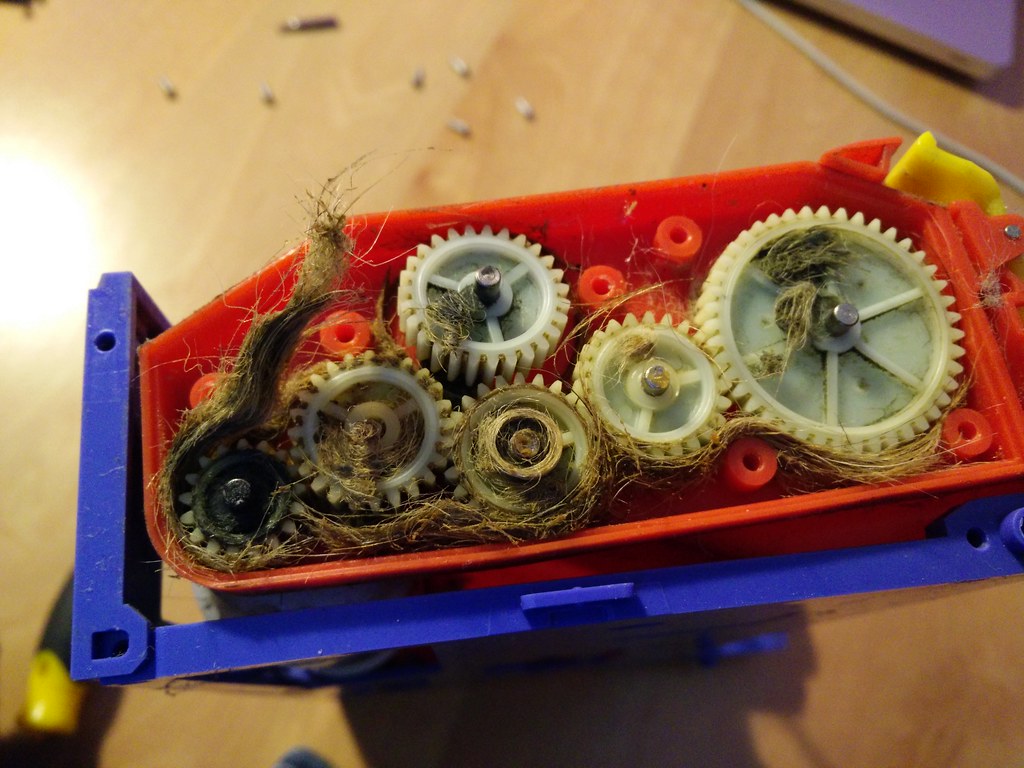
As is often the case when you get a second hand ‘needing repair’ item, people neglect to mention that they’ve taken it apart at some point in the past and it’s missing a bit. One of the gear axles was missing – its plastic support snapped off and oddly, not in the gearbox. The gear seems to have been held in place by the dirt and crap surrounding it.
After cleaning the gearbox it was very much apparent that gear wasn’t going to stay in place any longer (and it was probably why the Roomba had made some odd noises while running).
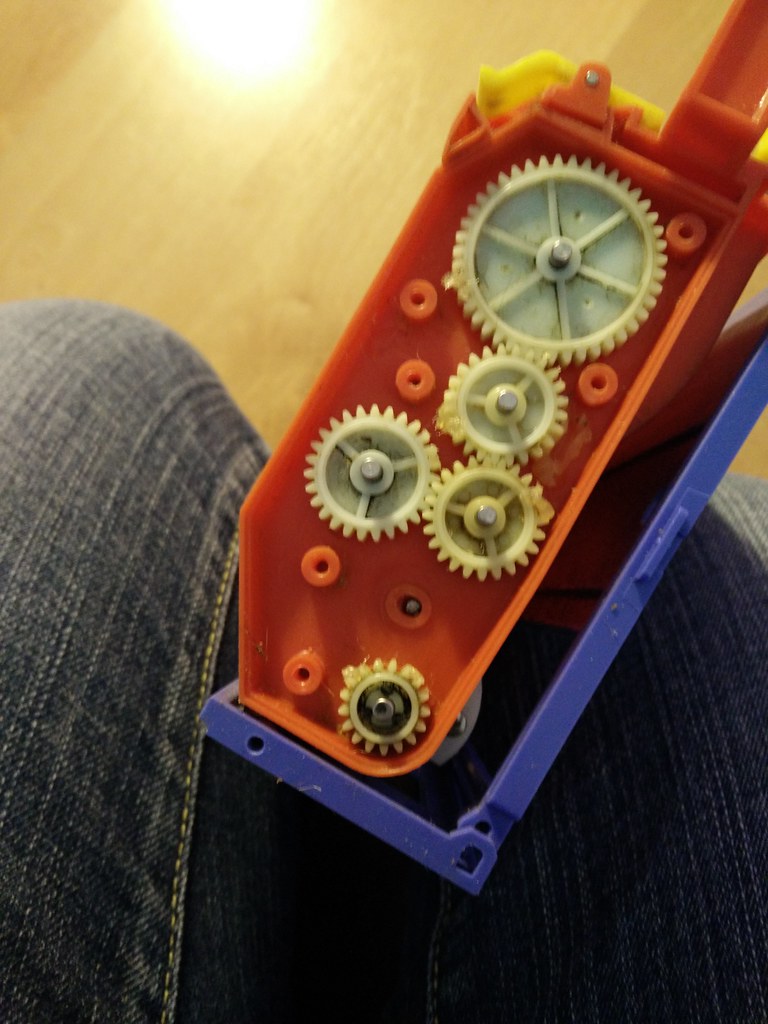
Fortunately, my dad’s magic box of tiny machine screws came to the rescue.
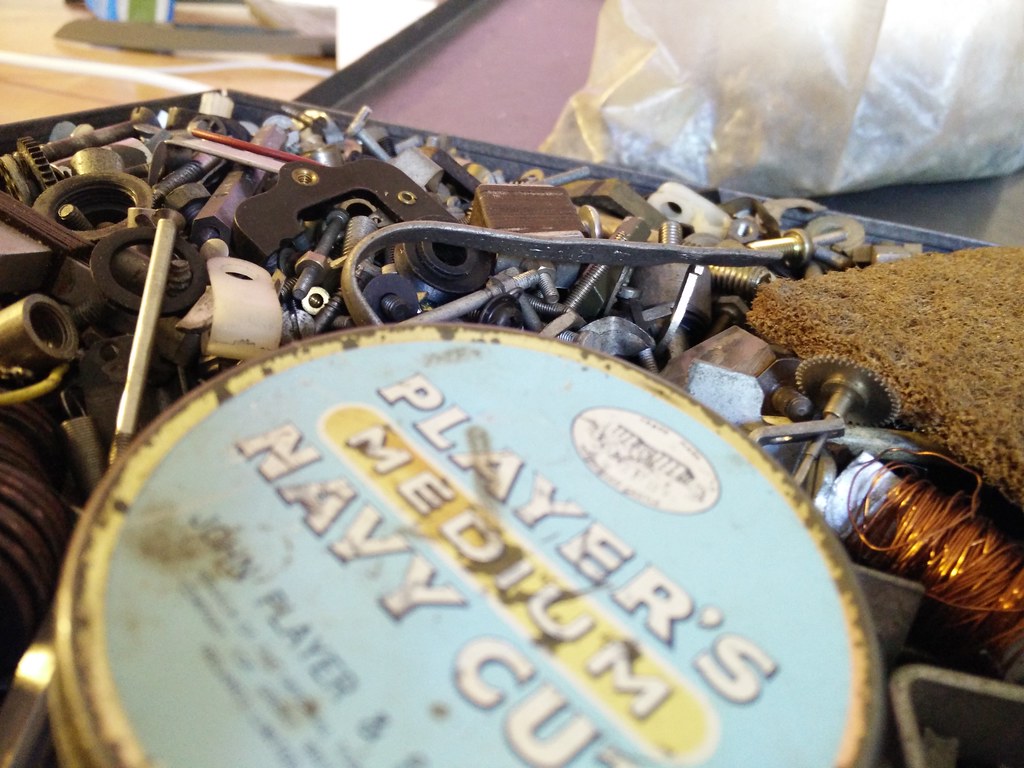
Not exactly OEM I’ll admit, but it’s fortunately a gear that is positioned such that the screw I’ve popped in to support it won’t collide with anything else.
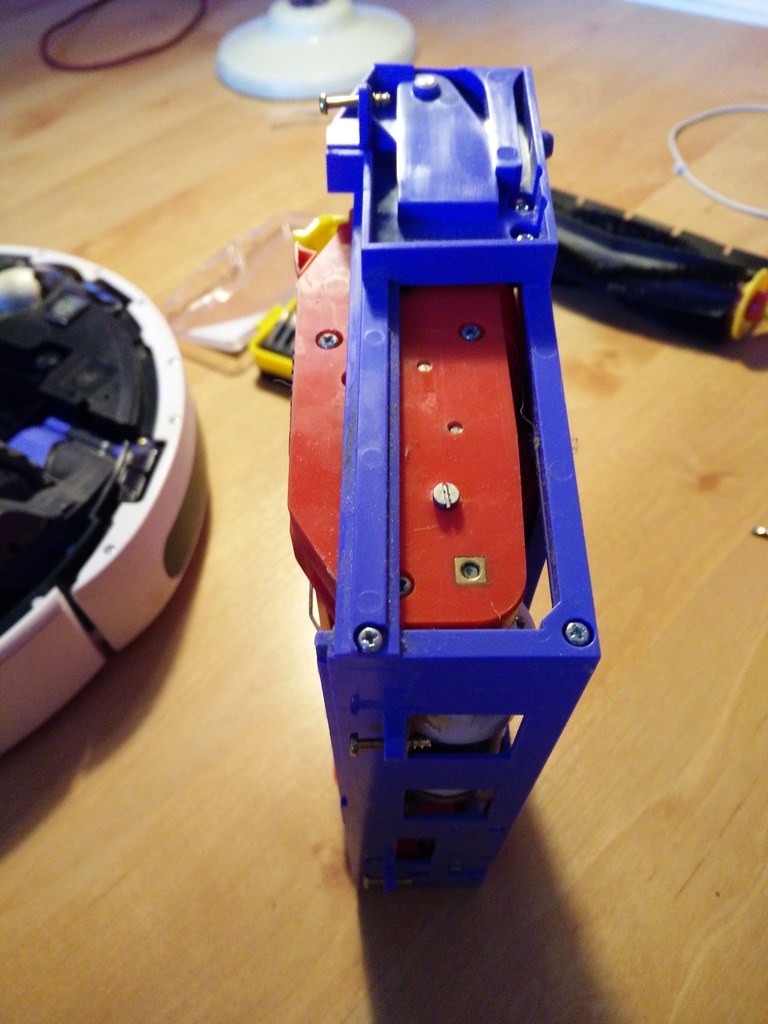
I expect it will, at some point, need a new gearbox – but we’ll see how it does for the moment.
I took the opportunity to strip down lots of other bits and remove the hideous quantities of dog-hair from it, too, and stripped the existing vacuum box down – and cleaned it – which might transiently improve its performance. Cleaned off the leaked-battery gunk – from an old battery that’s clearly been replaced without bothering to clean up the connectors. Generally gave the poor wee beastie a bit of love.
And we’ll see how it does. Overall, it’s nice how servicable the 500 series Roomba is. I’m quite startled at how much is accessible and strippable. It’s also pretty amazing how shit some of the design is. I’m told the 600 and 700 are somewhat better – and many of the parts are interchangeable. At any rate, for the moment it seems to be doing its thing, trundling around and vaccuming up stuff. If the new vaccuum bit does its stuff then I think it’ll be exactly what I’d hoped :)
* I’m not convinced its ever had a new filter, the filter on it is so revoltingly filthy. I’ve ‘dysoned’ it just so I could test it, but it’s completely clogged. Rather than spend money on a new filter for the old style vacuum box, I thought I’d get the new vacuum box design which apparently is more effective.
ETA: So, I suspect having run it through a little test cycle *and the first cycle where it ever made it back to the charging station before the battery died!) that in fact, the gearbox never worked properly before. Because it picked up waaay more crap than it ever has before. Pine needles and such all made it into the collector… it also didn’t make unpleasant graunchy noises. Wahey.
-


Watch: SNL destroys the homophobia behind “religious freedom” bills.
Not only is this a brilliant takedown of the religious freedom bills, this is brilliant satire of the whole Evangelical Christian movie industry.
-







-









8 Year old Mari gives a few facts about the Flint Water Crisis
Please don’t forget #Flint. Spread the word! #Love it!
-
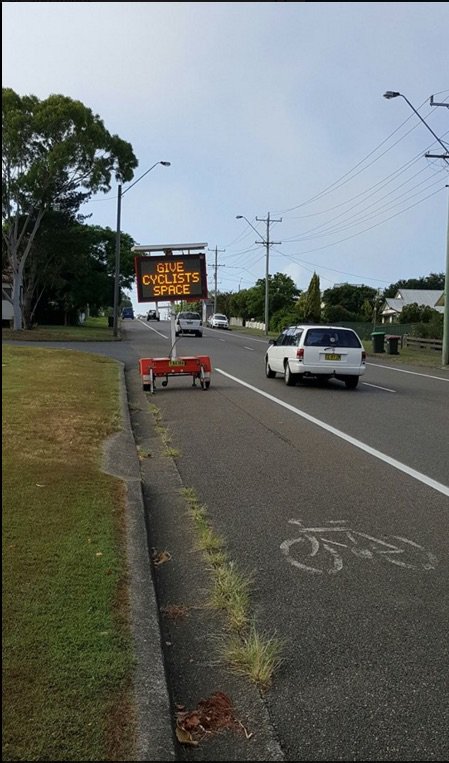
goddammit tony what did i say
I see this and suddenly I AM BECOME A BEING OF PURE RAGE.
-









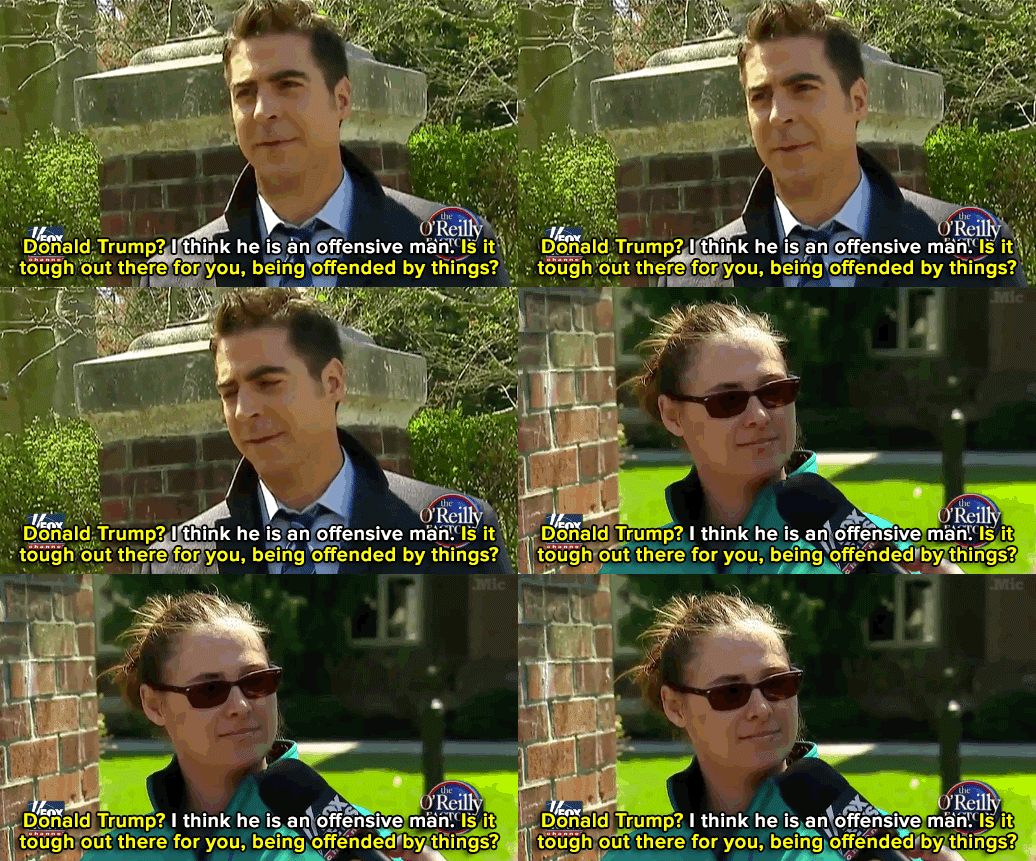
Watch: Fox News sent a reporter to Princeton to make fun of “sensitive” college students
they have so little respect for the intelligence of this generation
Disgusting
Fox reporter: What do you think of this blatantly offensive thing?
College students: I don’t appreciate the light-hearted dehumanization of fellow human beings
Fox reporter: lmao listen to this sjw bullshit #lol #kek #triggeredseems familiar
It’s like looking at a robot programmed using posts from Reddit
A bigot robit.
A bigbit.
The worst robot ever ;_;
I thought this was some kind of parody :P
-
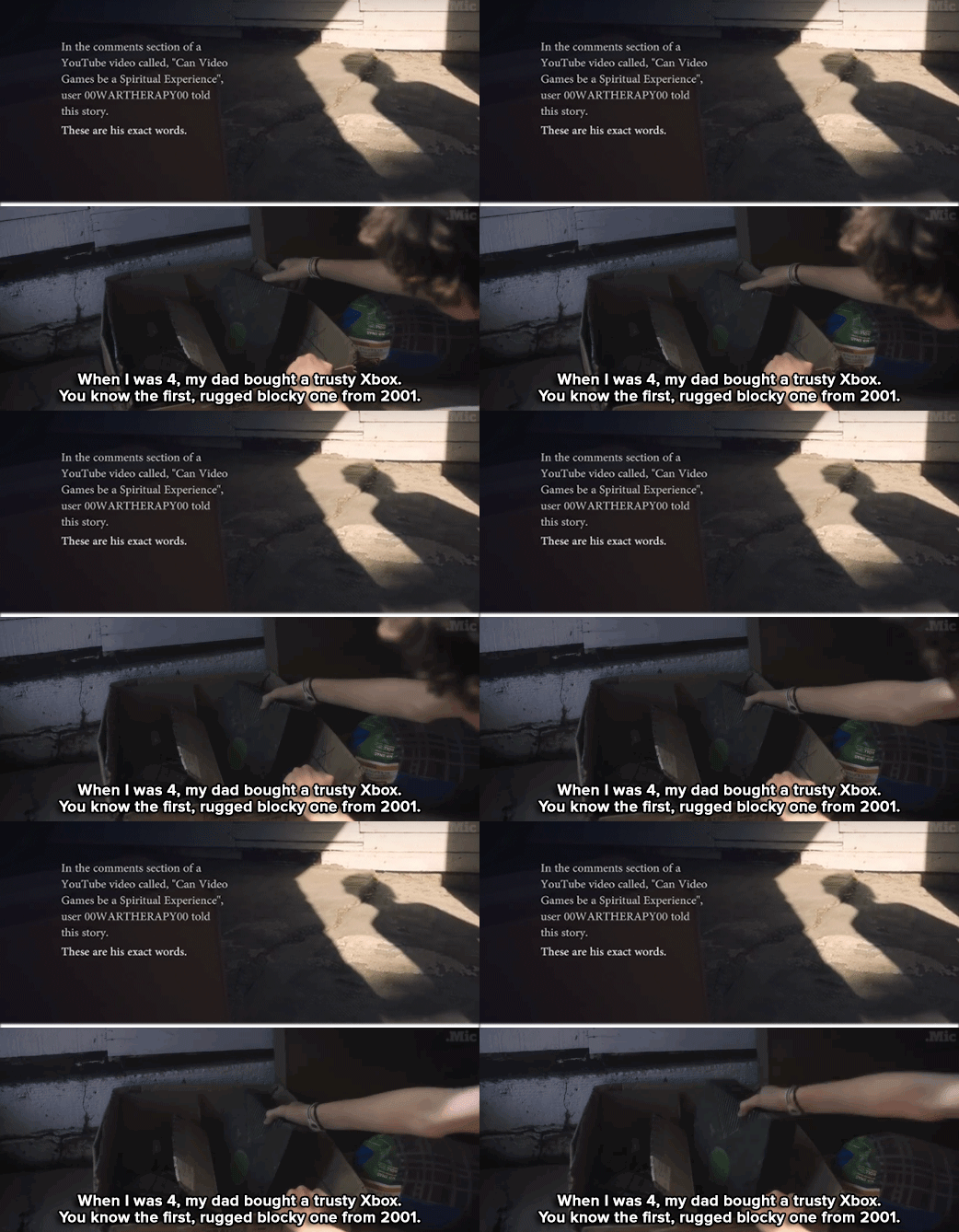
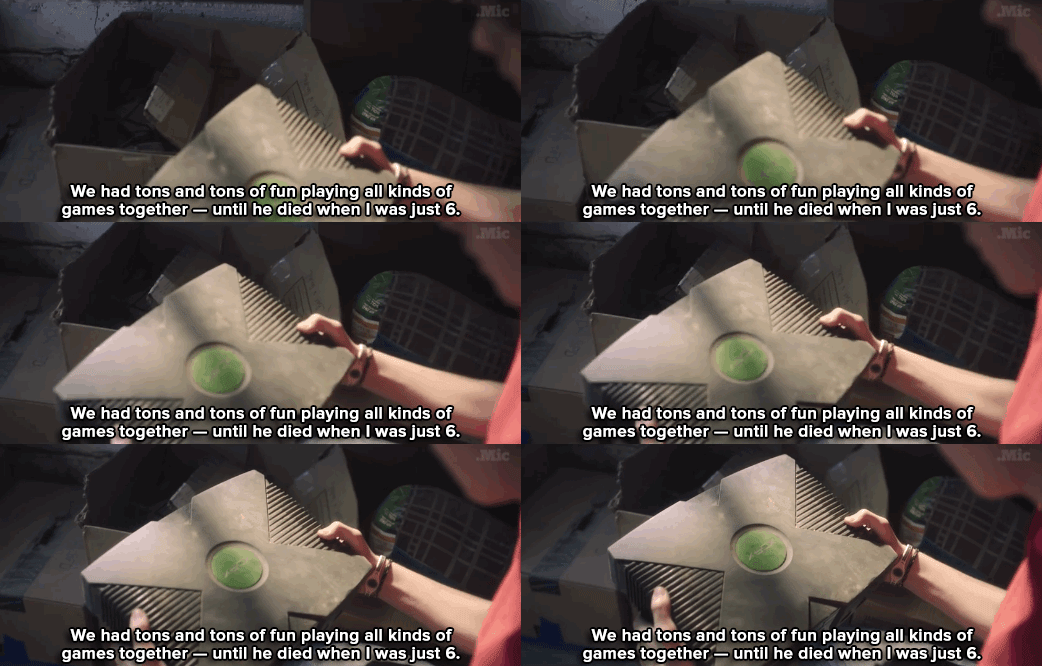
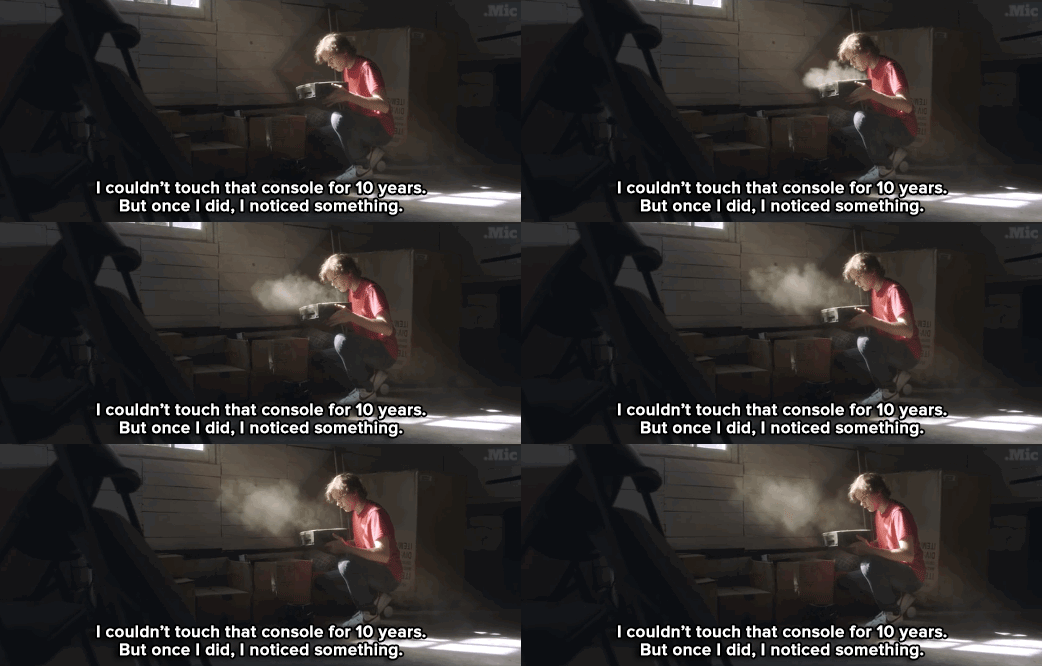
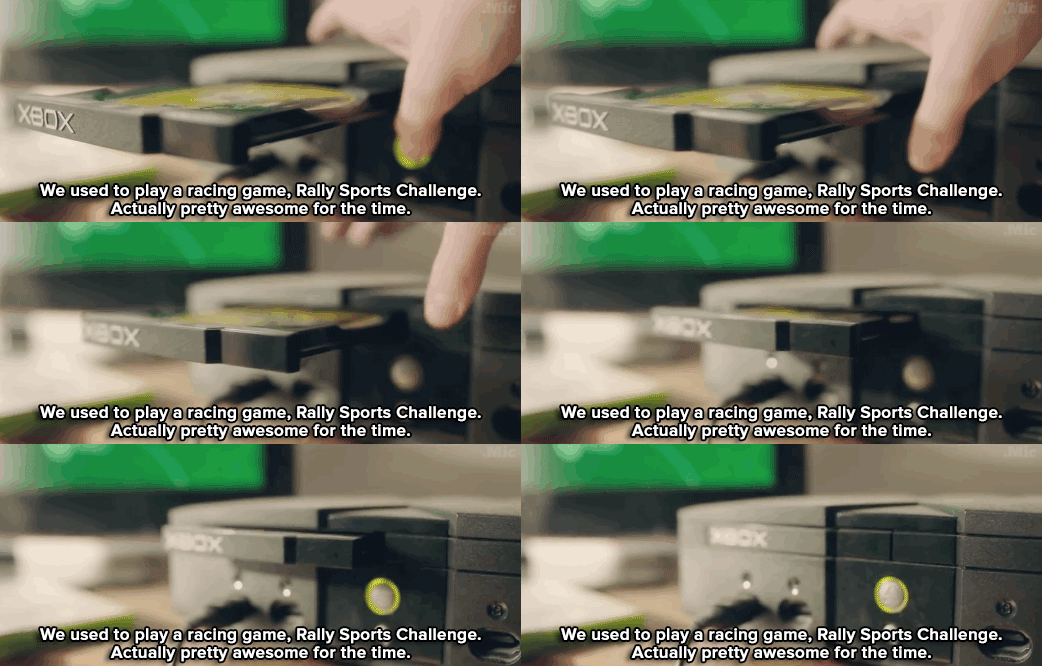


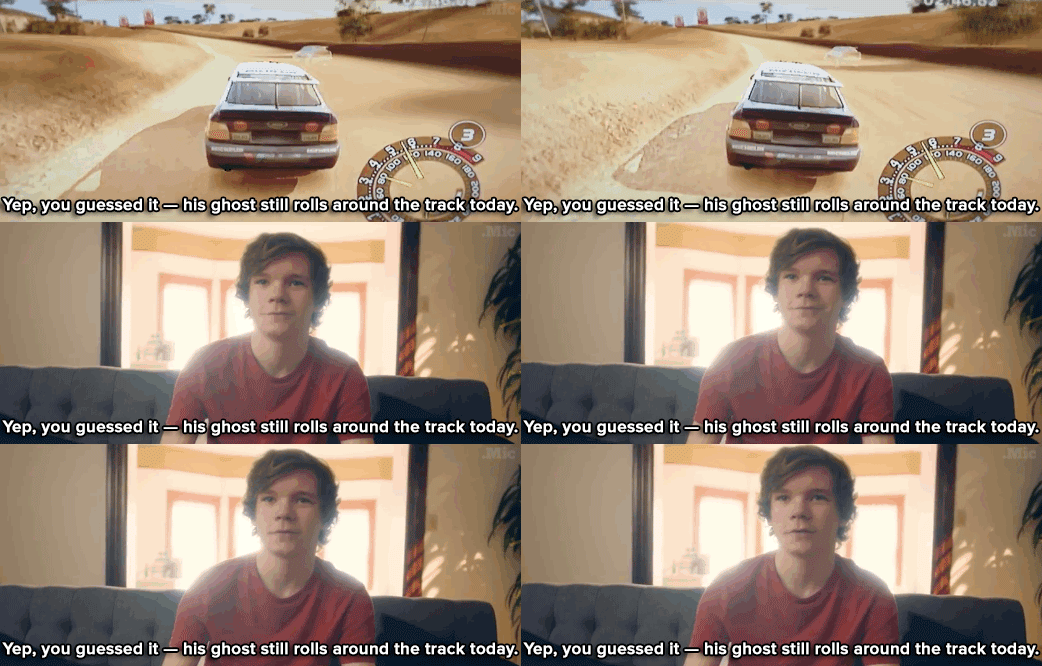


Watch: Can video games be a spiritual experience?
Follow @the-future-now
My favorite video game story ever