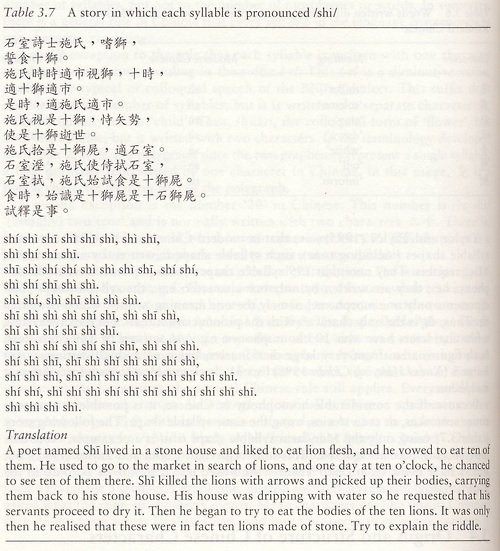
Holy shi… I know the concept that everything depends on intonation, and the way something’s said completely changes the word, but… Chinese (in any of its dialects) scares me. :-o
Wenn hinter Fliegen Fliegen fliegen, Fliegen fliegen Fliegen nach.
i am having a significant amount of trouble finding enough information on men’s wigs/hair care in the 18th century. a lot of the same information keeps getting repeated. here’s what i want to know:
did hamilton wear a wig or powder his hair? at the very least it doesn’t look like he’s wearing one in the ezra ames portrait, but that would’ve been when wigs had pretty much gone out of style. i mean, after studying a bunch of portraits i’m under the impression that it’s his natural (fairly curly) hair, but i really don’t know.
if someone powdered their hair, how often did they do so and how often did they remove the powder? i know it was messy and greasy, it seems difficult to sleep in.
if a man wore a wig, did he always shave his real hair?
did men sleep with their hair in a queue? did they use some kind of hair net to keep their pillows clean?
honestly, if you know the answer to any of these questions (or if you just have some thoughts to add) hmu. i swear there’s a reason i’m asking, though it’s not a very good reason.
Hamilton powdered his hair. His son James remembered that his father had basically a daily hairdresser who powdered, pomatumed, combed, platted, and clubbed his hair back in a queue. That kind of hair styling had the potential to take a couple of hours. It was generally believed at this time that the hair powder is what kept the hair clean.
I can’t find info on how often they removed the powder, but to keep their pillows clean when their hair was powdered, they wore night caps,
*cracks knuckles* Finally, my time has come! *uses interest in 18th Century fashion and grooming for good and not for evil*
A typical hair care and styling regimen for women, and fashionable men who did not wear wigs, in the 18th century was:
1. Take down your hairdo at the end of the day, massage a small amount of pomatum, a mixture of mutton fat, lard, and aromatic oils such as clove and lemon, into the hair and scalp, add powder, and brush vigorously for quite some time. The effect is similar to contemporary dry shampoos. Although very rarely, if ever, washed with water and soap, this routine effectively cleans the hair and scalp without stripping natural oils and leaving it full of texture and body and enough oils to make styling easier– squeaky clean, freshly shampooed hair is notoriously hard to style, especially in elaborate updos and curls. Men and women alike wore nightcaps to protect their bedding from any powder or pomatum that might be left and probably also to help prevent long hair from getting too messed up. Unlike women, men might not undo their hair every night, and would wear hairnets to help preserve their style overnight.
2. In the morning, more powder was added before brushing. Powder was made of finely ground starch, bones, and clay, along with aromatic powders such as orris root. Women who wished to achieve towering ‘dos rolled sections of their hair over fluffy pads and added curls with curling irons. Men usually did not have the towering hairdos, but definitely would have added curls with a curling iron, if they had the luxury of a hairdresser (I read that Hamilton had a hairdresser come to his house every day, so he may have added curls sometimes). If a lighter white color was desired, the hairdresser would apply more powder to the finished style with a large puff while their client covered their face with a cone-shaped piece of paper so it didn’t also get powdered.
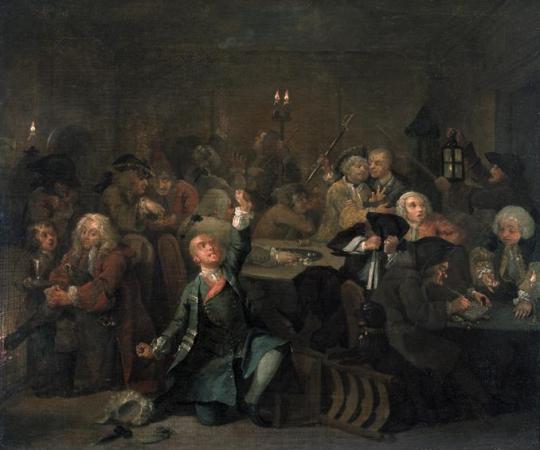
3. Wigs. Contrary to popular belief, women achieved many of their towering hairstyles without wigs. Most women wore their own, natural hair with, perhaps, extensions to bulk it out a bit if necessary. However, most of the popular, everyday styles could be achieved simply with waist-length hair, pads, and curls. Men, on the other hand, routinely wore wigs. Covering baldness was a big part of wigs’ popularity among men, but also, the time involved in styling hair may have interfered with men who had business, politics, and other important matters to attend to. Wigs could be sent off to a professional for regular maintenance and simply plopped on the head in the morning, like a hat. Men who wore wigs usually kept their natural hair cut very short, or even shaved, as in this picture from Hogarth’s “A Rake’s Progress”, where the main character has let his wig fall to the floor:
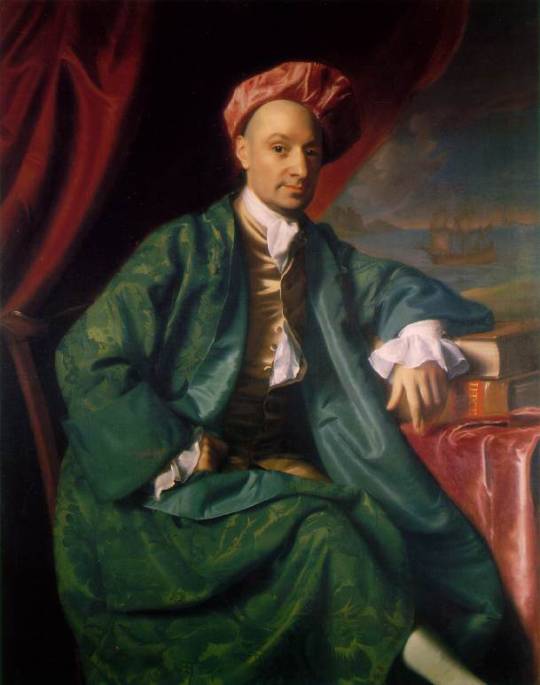
And this handsome gentleman, lounging at home in informal leisure wear– a banyan and nightcap:
Because wigs were expensive, they marked social class, with the most elaborate styles that required the most upkeep for the wealthy and the fops, and simpler styles that varied according to occupation and income.
By the late 1700s, however, wigs were already on their way out. Men of all social classes preferred styles that were fairly simple, and by the 1780s, natural, lightly powdered hair was preferred. In most of the portraits of the Founding Fathers and others who fought in the American Revolution, for example, you see that they are wearing their natural hair, not wigs.
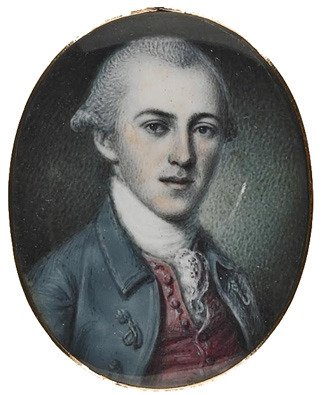
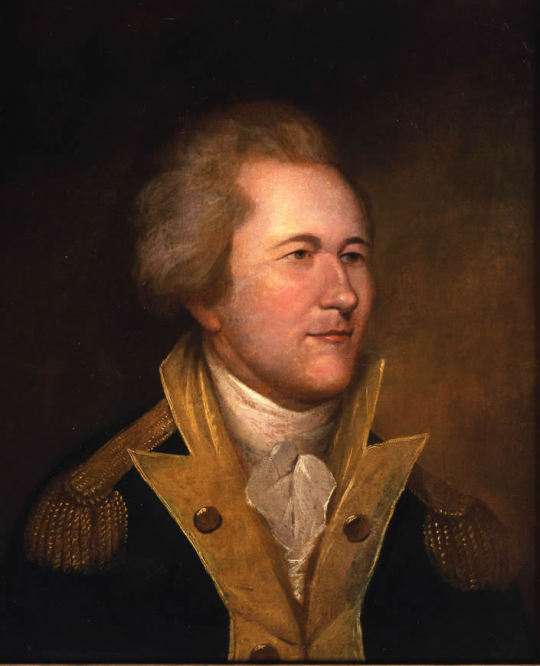
Hamilton, ca. 1780– this is his own hair (I’m assuming, because the hairline is consistent with other portraits and he was probably too poor to even own a wig at this point), but it has been styled to look very much like the popular wig styles of the 1770s-early 80s: brushed back from the forehead, rolled over a pad or simply bulked up with enough pomatum and powder to make a nice roll near the ears, and tied in either a queue or bag in the back:
Which is, incidentally, how George Washington wore his hair, and since Hamilton was his Aide de Camp at the time this portrait was painted, it’s not surprising he wears the same style as his commander.
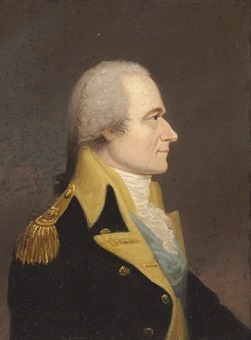
By 1800, he was wearing his hair like this:
It looks to me like the sides have been curled or rolled vertically to frame his face, while the back is combed flat and tied in a low queue.
This is another view of the same general style. You see the lightly powdered hair brushed up and fluffed a bit with the help of pomatum and powder for volume and hold over his head and around his face. You can see that by the late 1700s-early 1800s, men’s hair was fairly natural-looking, and required a minimal amount of styling and maintenance.
In England, in the 1790s only older men and women being presented at court wore wigs, and in 1795, the British government levied a tax on hair powder that basically ended powdered hair and fashions that relied upon it. However, powdered hair was already mostly over in the US, France and with political progressives in England because of the revolutions: elaborate, powdered hairstyles were associated with aristocracy.
“Because I was black, that’s why they stopped me,” Sims told KIRO 7 last week.
Seattle City Council President Bruce Harrell wants to know how often that happens.
“Let’s look at the data, let’s
look at it to see what’s trending, let’s have the officer explain why
they stopped (someone),” Harrell said.
SPD is under a consent decree with the U.S. Department of Justice, which includes practices to monitor and prevent racial bias.
That consent decree will end after
the city fully complies for a year so Harrell wants to put bias-free
policing standards into city code so that practices continue after the
expiration.
He also wants to expand on
anti-bias practice by collecting and analyzing demographic data on
police stops, and creating a system for people to easily file legal
claims against the city if they’ve been racially profiled.
In some cases, officers might be called before a hearing examiner to explain why they made a stop.
Payouts for cases before a hearing examiner would be capped at $5,000.
“Most people aren’t looking for
money in this situation. They’re looking for a rational and plausible
explanation for why they were stopped,” Harrell said.
Harrell addressed a question from
KIRO 7 about whether his proposal would contribute to what’s known as
“de-policing,” a hesitation to pull people over.
“That’s always a concern. If a
police officer isn’t willing to do their job and do their job
effectively, perhaps this isn’t a good line of work for them,” Harrell
said, adding that he expected officers would embrace the idea.
KIRO 7 reached out to the Seattle Police Officers Guild but received no response.
Harrell said he would wait to
formally introduce legislation until after an August meeting about SPD’s
compliance with the consent decree, and until after the outcome of a
police guild contract vote is known.
If men stopped working…the world would continue on.
If women stopped working, then things would get ugly.
What?
there has been an instance where this happened. it was 1975 and icelandic women decided not to work for one day.
working as in cooking, cleaning, taking care of the children, doing chores and so on, not only “not showing up to your workplace”. women did nothing that day, except showing up in reykjavik and protesting for gender equality, equal pay and equal representation in parliament, you know, cool stuff.
you know what happened? havoc. men were left with food to cook and children they never took care of to pick up from kindergarden and entertain for the day. they went en masse to the food shops buying sausages because they could cook nothing else, they had to bond with children they never spent more than a couple hours a day with. they struggled combining their work day and the domestic tasks they had to sort out. and this just for one day.
iceland in 1975 stopped working and things indeed got ugly. so ugly that women in the following decades became woke AF and soon it happened that women became president, took half of the seats in parliament and achieved one of the best living environments in the world.
is your astonishment solved now?
We already know what happens to countries when the majority of the male workforce is removed. It is called “war.”
If you want to read Highly Documented and Very Historical accounts of how countries function without internal male labor, you can start by diving in to World War 1 and World War 2! (I’m just gonna talk about the Allied forces because my English is best
and I know the most about them, but the Axis powers had similar
dynamics!)
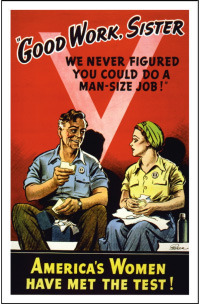
See, when the warring civilizations threw every able-bodied man they could at war fronts all over the planet, this left enormous labor vacuums. Not only did the countries have to function without male labor, but they also had to funnel vast amounts of food, clothing, ammunition and weapons to the men in combat. By WW2, women were needed in every possible role that didn’t include active combat.
If you send millions of men to combat, then the resulting millions of empty, necessary, “male” jobs must be done by women. That’s just how it works.
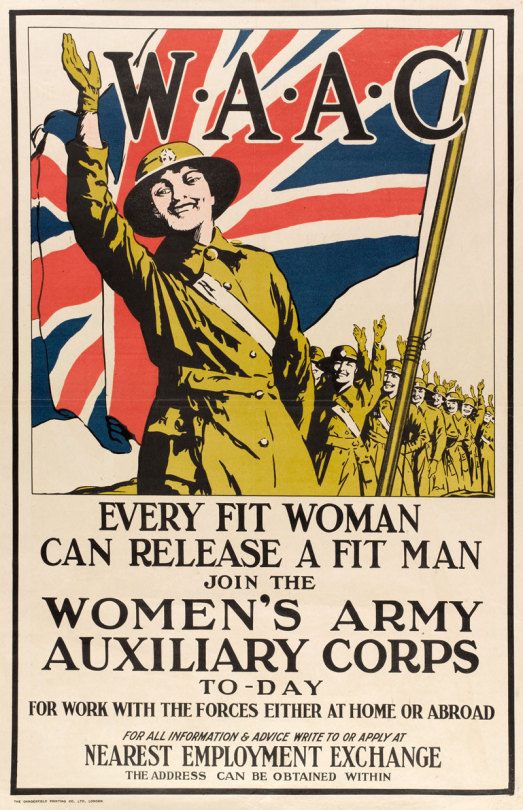
This is an British WW1 poster from 1917. It says it succinctly – every woman who takes a “male” job in the military, frees up that man for active combat.
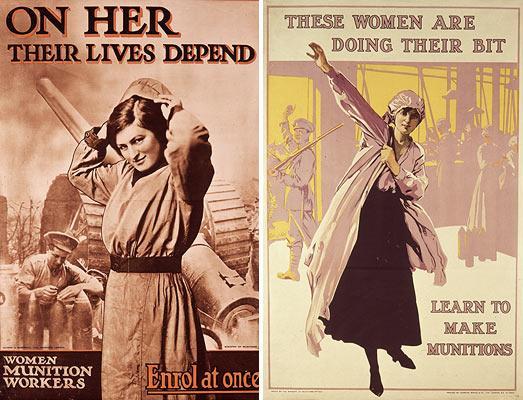
One thing that you can’t get enough of in war is bullets! With men spending bullets but not making them, the women need to do it. These WW1 posters from around 1918 are pretty cool – the woman “doing her bit” has shades of Art Nouveau, I think.
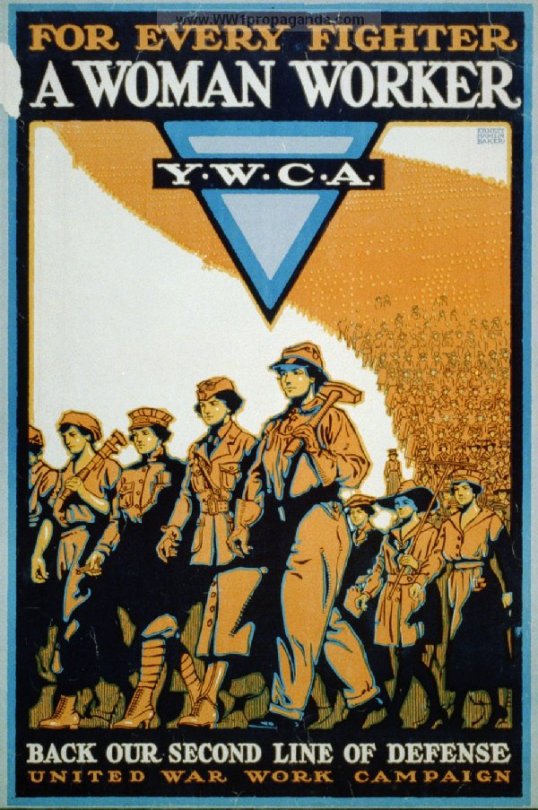
Here’s an American WW1 poster in which the women are dressed as mechanics, train drivers, military support, manufacturers, farmers and nurses. I like the cool Victorian shoes and the baggy trousers. Isn’t it funny to think that this happened between the Victorians and the flappers?
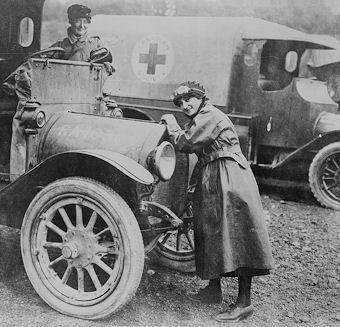
In WW1, you couldn’t even afford to spare able-bodied men to drive ambulances in warzones. Ambulance drivers on the Front were largely women. They picked up the wounded and dying men and took them to field hospitals staffed largely by women.
By WW2, the women of the Allied nations were SO ON TOP OF THIS.
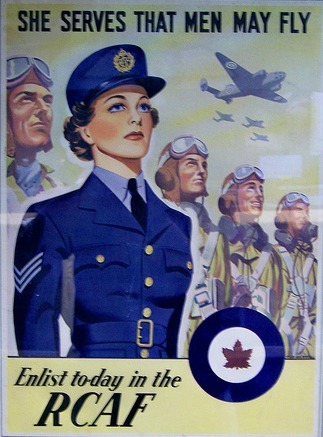
Here is a Canadian lady from the 1940s. Women in Air Force support were vital – men were the fighter pilots, women were transport pilots – as well as doing the support roles like aircraft maintenance and preparation, parachute packing, communications and intelligence, managing the radar, plotting the weather, and, of course, doing the catering. The language on this poster shows that the woman does all of this necessary work to get the fighter pilots in the air. Every non-combat military job that a woman took meant one more fighter pilot and soldier in active combat.
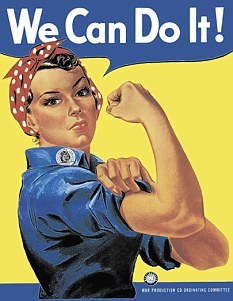
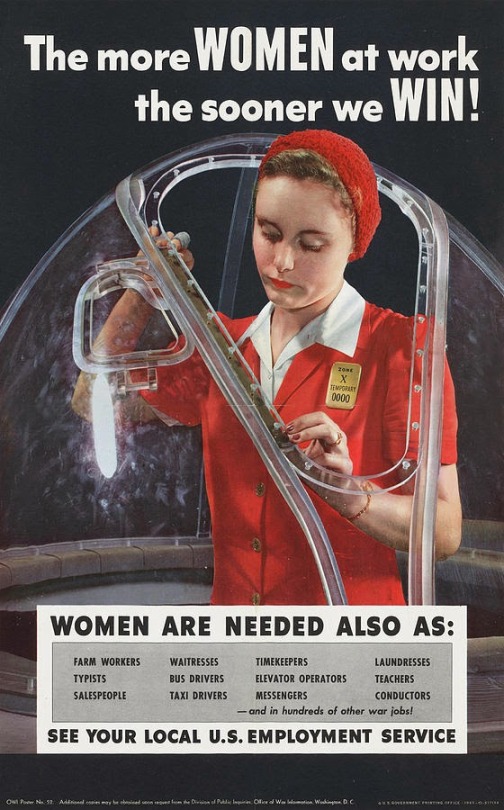
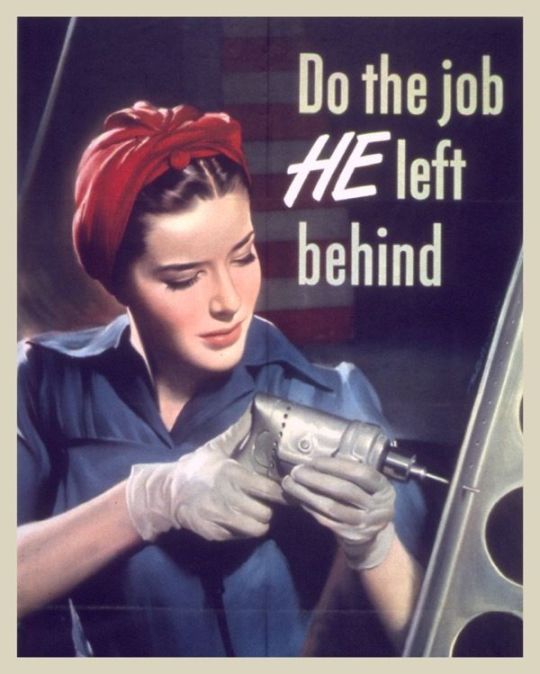
Back at home, people functioned fairly well without men in WW2. Everyone’s seen this American WW2 poster, you know she’s encouraging women to get into the factories and make All The Stuff!
HEY WE STILL NEED LOTS OF FOOD TO EAT AND THERE ARE NO MEN TO MAKE THE FOOD, SHOULD WE STARVE?
NO WE SHOULD NOT
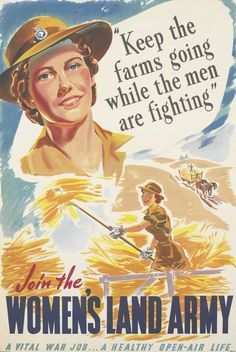
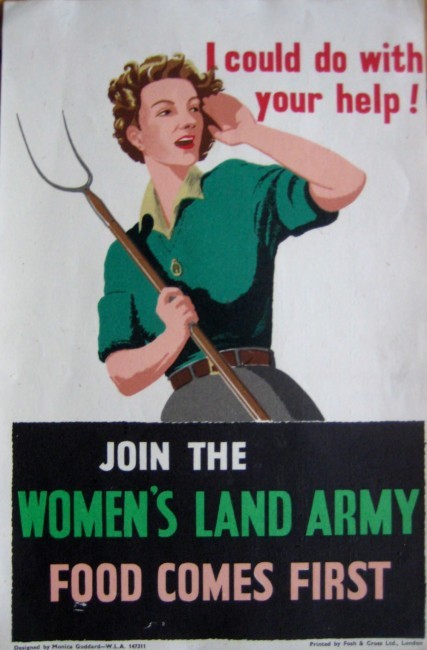
THIS AUSTRALIAN LADY IS GOING TO FARM ALL THE THINGS
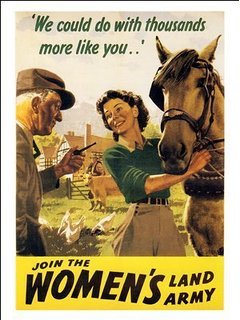
Land Armies (staffed by Land Girls) were super necessary to feed everyone at home PLUS everyone at war. Land Girls were used in both WW1 and WW2. While farming was a “protected occupation” (male farmers wouldn’t be forcibly drafted into the military, because their jobs were too important to a functioning society) the majority male farmworkers decided to enlist voluntarily. This left elderly or disabled male farmworkers to do intensive work. By WW2 they had some tractors to help, but most farming was still done by hand or with draft animals, especially since the steel and fuel for the tractors was more needed on the Front.
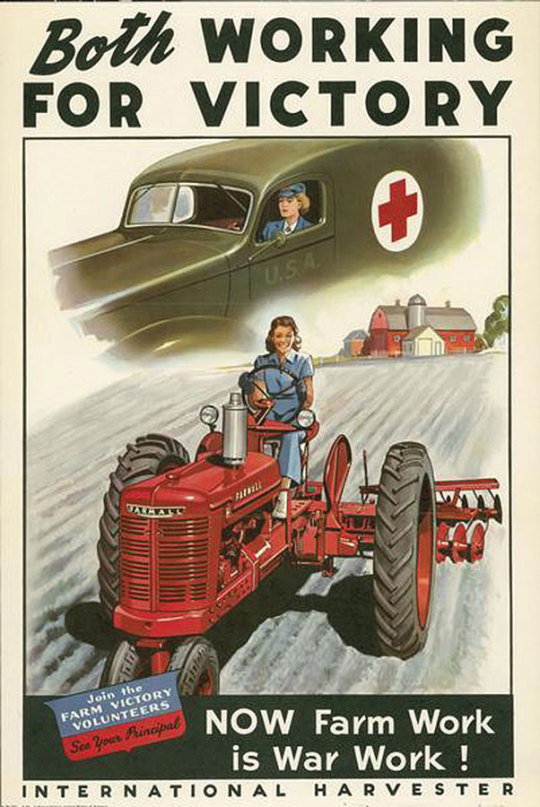
This American lady found a cool old-timey tractor, which is just as good as an ambulance…
But this British lady has to do her plowing with a draft horse! The weathered old farmer, too old for combat, is very grateful.
FOOD COMES FIRST!
okay but LOOK at some of these other Plushy Man Jobs, Necessary To Prevent the Downfall of Society, that American women needed to do RIGHT NOW TO BEAT THE NAZIS:
AMERICAN WOMEN! THESE ELEVATORS AREN’T GOING TO OPERATE THEMSELVES
I CAN KEEP GOING FOREVER
TAKE THE JOBS FROM MEN!! TAKE THEM!! SEIZE THEM!! DRILL THE THING
Oddly, even without men at work, “women’s work” still got done.
Children were still mostly looked after. Large communal childcare programs were set up (they were quickly closed after WW2, though.) Food was prepared. Households
ran. Single women stayed single. The countries functioned. The world still turned. MILLIONS OF MEN
were WIPED OFF THE PLANET but the world still turned.
In fact, the Allies won both WW1 and WW2.
And the resulting power/gender/employment vacuums shaped the gender dynamics of most of Tumblr’s parents and grandparents.
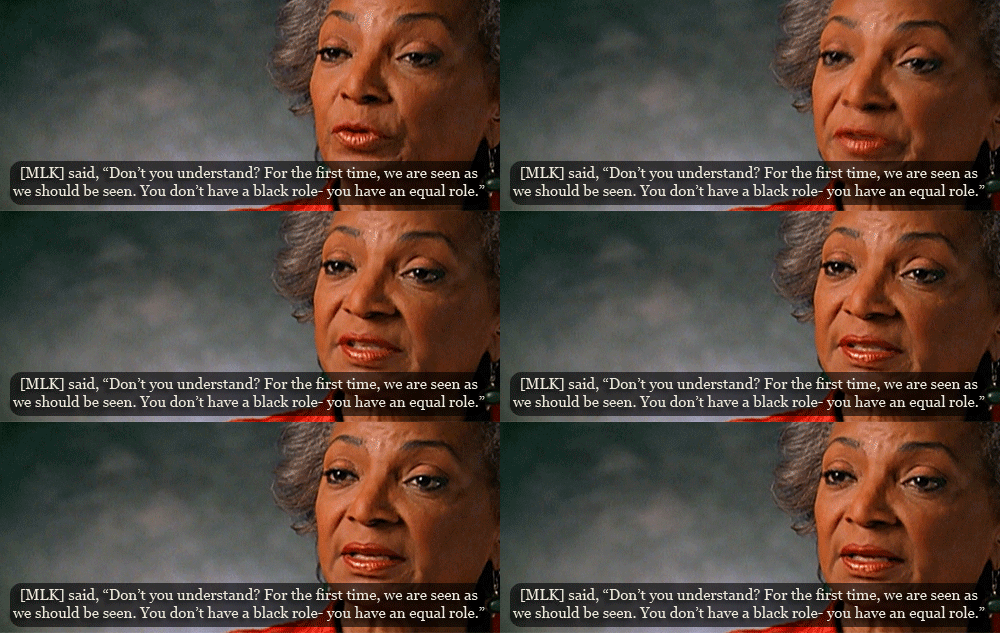
oh my god. Imagine being Whoopi and hearing that though.
Well,
when I was nine years old Star Trek came on,“ Goldberg says. “I looked
at it and I went screaming through the house, ‘Come here, mum,
everybody, come quick, come quick, there’s a black lady on television
and she ain’t no maid!’ I knew right then and there I could be anything I
wanted to be.” – See more at: http://www.startrek.com/database_article/goldberg-whoopi#sthash.gKeuf3XI.dpuf
That’s three generations. Nichelle Nichols to Whoopi Goldberg to Leslie Jones.
stop romanticizing mic dropping… damage to sound equipment is no joke
Modern stage microphones for concert use are actually designed specifically with mic dropping in mind. When the move started to become fairly popular amongst performers back in like the early 90’s manufacturers started making their products more durable so that sound technicians didn’t have to buy a new mic every concert. The biggest concern most sound guys have when mic dropping is concerned is actually the feedback that’s going to be coming from the mic when it hits the ground. That’s why you always see the performers hold the mic out for a second before they actually drop it, to give the dude at the soundboard time to mute!
thank u sound technician side of tumblr
On the other hand, DO NOT DROP your instrument microphones. They’re often ilttle condensers and they prefer more care.
That classic SM58, though, you can probably drop kick.
A little SM58 story…
So many years ago (in another life) I was setting up a recording studio as part of a business I was a partner in. We decided to offer a free recording session to some friends-of-friends to test out the kit. In our house – because we’d not got an actual studio space yet (long story, not funny).
So the group turn up and we mic up the drum kit and connect up all their gear and then we discover the drummer likes to play with the wrong end of the drum sticks because the normal drum hitting end is ‘not loud enough’.
May I point out that this is taking place in the bedroom, that we’ve cleared specially, in a small victorian terraced house.
After several painful, painful hours our SM58 mics had stood the test really rather well. Our ears, not so much. I have now blanked the phrase from my mind, but the song’s chorus was a chant that I think our entire street was begging to get out of the brain for the following few months…While they waited for their hearing to recover too.
Sadly, while the SM58?s had done well and survived the lead singer attempting to eat one, and the drummer’s historic onslaught on the drumkit, our shiny shiny JBL monitor speakers were fucked. Completely.
Okay but to build on my previous space ideas – there is no good reason why aliens from different planets would all be similar sizes. Imagine 6? tall aliens being in the general vicinity of lots of other alien worlds but never bothering to get spaceflight together to meet them bc they’d just get stepped on
But they still GalaxySkype with them all the time and do friendly knowledge transfers, and the Smols are very friendly and happy to upload info on all the unique flora on their homeworld
And some Larges discover that the Smols are having problems because there’s not much of some certain element on their planet and they’re running out and… “a lot” to them is so little, the Larges offer to send over like a storage pod’s worth and the Smols are like “:OOO WE CANNOT AFFORD”
The Larges would be like “no no it is okay, it is not much to us. It can maybe be written off on our Space Taxes? Do not worry about it”
And the Larges insist on sending the storage pod to a large flat area like half a day’s travel outside of the nearest Smol city because they are so worried that if they did their landing calculations wrong they will incite a small quake that will cause tiny buildings to topple
The Smols trek out and are overjoyed at the enormous metal box full of conveniently-small bars of metal. They empty it out and transform it into a multi-level museum dedicated to interplanetary unity and their special friends the Larges. They take and send pictures of tiny Smols in school groups wandering through the halls and learning about the nice space giants that made their prosthetic tentacles possible