Sometimes I just start singing and my mom joins in
Whoa…
#don’t trust this
#they’re probably sirensThat, my friends, is the O Magnum Mysterium by Tomás Luis de Victoria. I would love to live in a house where people just casually sing music like this
No. These people are, in fact, sirens.
Blog
-
rina_takei The window washer is back to play with Guinness
I’d be willing to bet that this is the highlight of both of their days.
-
-
Make Some Pocket Extenders for Your Pants
So I don’t know about you, but I’m often frustrated by the ridiculous smallness of girls’ pockets. At a bare minimum, I need to be able to shove my cellphone in there – come on, pants companies! So what I started doing was making myself pocket extenders. I’ve done this several times, for pants and shorts. It’s great.
I just got this pair of jeans, so I thought I’d show you how to do it. I kind of feel like it just hasn’t occurred to some of you that this is an option, so maybe now it will. All you need is your pants, some fabric (I just took a random piece from a scrap bin), a needle, and some thread (thread doesn’t even need to match the fabric since literally no one will see it).

See? Ridiculous. Like, half a cellphone, or only 2.5?. Useless.

So turn those inside out to expose the pockets.


Figure out how big you want your pockets to actually be. I kinda go by whatever looks like might be right. I didn’t
really measure them. Fold the fabric in half, so you have a pocket, and
then fold it in half again so you can have two equal ones.
Try to get the edges to line up enough, pin it in place, then sew up the sides! Are your stitches crazy uneven and wonky looking? Doesn’t matter; nobody’s going to see it. These are in the inside of your pants. The only thing that matters is that it holds up. So I double-did the corners, since those tend to get the most stress.

Cut open the bottom of the existing pockets.

Pin it in place, then sew around, joining the new pocket to the old pocket. I did this by keeping my hand on the inside, so I wouldn’t accidentally sew through the other side. Again, I reinforced the corners, and didn’t worry about what it actually looks like. Then I turned it in side out to make sure the inside was all joined properly.

Yay all done! And the pockets are so much bigger now!

Whaaaat I can fit my entire phone and entire hand and probably something else now, are girls’ pockets even allowed to do that?! Heck yeah they are.
You are a goddamn hero.
-

I really want to read their essay
Why can’t we see the essay? I’d love to read it.
-

Bruce Springsteen dropped all shows from North Carolina because of the new bathroom law they passed.
About 50 of the comments were similar to this one.
WHAT BATHROOMS ARE THESE PEOPLE GOING TO?
Even in male bathrooms, there is no flopping. We do not flop. We do everything in our power to make sure that no dingle is seen by anyone.
And since women’s bathrooms have STALLS, even if you did flop it around, no one would see it.
Who gave this woman the idea that there is flopping? THERE’S NO FLOPPING YOU BIGOT.
No six year old is going to accidentally or on purpose have a floppy experience. HOWEVER, this stupid law might cause transgender folks to get beat up or even killed.
People suck.
-
“it’s not been a great week” david cameron says to a hall full of supporters, who laugh about his tax evasion. meanwhile, to date, the number of disabled people who have died after being robbed of their ‘benefits’ declared “fit to work” under tory policy is in the thousands, likely tens of thousands. this is despite disability benefit fraud being 0.7%.
they know they’re killing us. they just don’t care.
-
74 years ago today, a terrible thing happened on Bainbridge
It’s impossible to ignore the racism of this year’s Presidential race; Donald Trump will say anything, it seems, to gain support from the many Americans who truly believe that we need to build a wall at the Mexican border and that deporting all Muslims would somehow end terrorism. It’s sickening and it’s rooted in a legacy of xenophobia.
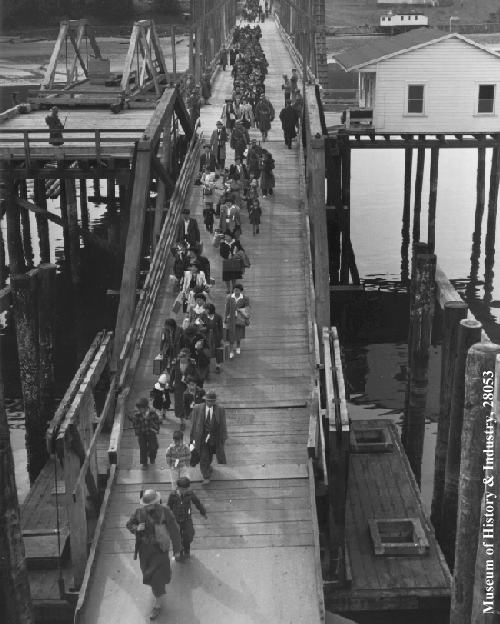
Image: MOHAI
It’s also familiar as hell, particularly along Puget Sound, where, 74 years ago today, Japanese and Japanese-American residents of Bainbridge Island—some who had been there for six decades and many who were born there—were wrenched from their homes and send to an internment camp under Executive Order 9066.
They were the first in the nation to be interred, due to Bainbridge’s proximity to a military base, and were given just six days to get their business and personal affairs in order. They had no idea how long they would be gone, or where they were going. Via the UW:
The Bainbridge Islanders, both aliens and non-aliens (i.e., citizens), were given six days to register, pack, sell or somehow rent their homes, farms and equipment. On Monday, March 30 at 11:00 a.m. these Japanese Americans, under armed guard, were put on the ferry Keholoken to Seattle where they boarded a train to Manzanar in central California. They were not to return to Bainbridge Island for more than four years.
Executive Order 9066 was written to protect “against espionage and against sabotage to national-defense material, national-defense premises, and national-defense utilities”—exactly the same reasons Presidential candidates like Trump give for the expulsion of Muslims—but what it really did was grant the U.S. government the authority to discriminate against American citizens and immigrants based on literally nothing but their race. It was an order that was the direct result of fear and intolerance.
The majority—a full 2/3—of the residents interned were American citizens.
There was a great gathering of white friends at Eagledale before the evacuation was completed. These friends, as well as soldiers, gave the departing Japanese every help.
It was a pathetic exodus.
There were mothers with babies in arms, aged patriarchs with faltering steps, high school boys and girls, and some children, too young to realize the full import of the occasion. The youngsters frolicked about, treating the evacuation as a happy excursion.
“Tears, Smiles Mingle as Japs Bid Bainbridge Farewell.” Seattle Times, March 30, 1942, pg. 1.
On Bainbridge Island—and up and down the West Coast—this action ravaged communities, separated families and friends, and financially ruined many individuals and businesses.
In 1983, it was estimated that the total economic fallout was something like $2 billion.
At the time, racism was rampant locally—but there were still some voices in support of the residents of Bainbridge Island, of Seattle, and of surrounding areas who were being threatened with internment.
After the first announcement of the executive order in February 1942, the only West Coast newspaper editors to write against internment were Walt and Milly Woodward of the Bainbridge Review. In their editorial they wrote that they “hope that the order will not mean the removal of American-Japanese citizens, for it [the Review] still believes they have the right of every citizen: to be held innocent and loyal until proven guilty” (“Not Another Arcadia”).
In total, 277 residents were forcibly removed from the island, sent to camps in California and Idaho, for the duration of World War II. Just 150 returned to Bainbridge when, years later, they were permitted to go home.
On the memorial that now stands near where the residents of Bainbridge were walked down a pier toward the ship that would carry them away, visitors can clearly read the words “Nidoto Nai Yoni.”
“Let It Not Happen Again.”
Despite the cutting of checks and an apology from Ronald Reagan, it’s evident that simply acknowledging our history isn’t enough to keep from repeating it.
Here in the Seattle area and throughout the nation, we are precariously permissive of rhetoric that not only condones but supports letting it happen again.
There are actively discriminatory groups putting in work across the county, including here at home.
Let it not happen again. Let it not happen again. Be part of the reason that it won’t happen again.