I’ve seen so many complaints about this. SO. FUCKING. MANY. And tbf, at any other time I would side with them, in that it is not ok to whitewash an already scarce major Asian role for the fuck of it.
BUT…. This is a sad case of truly shitty extraneous circumstances, and it looks like none of the people complaining understand why. So allow me to explain (and summerize for those who don’t know whats going on) The Ancient One (TAO) is a mystical and powerful being in the Dr Strange comics, and in the film is being played by Tilda Swinton.
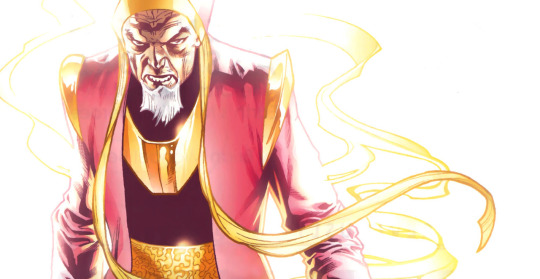
So this guy:
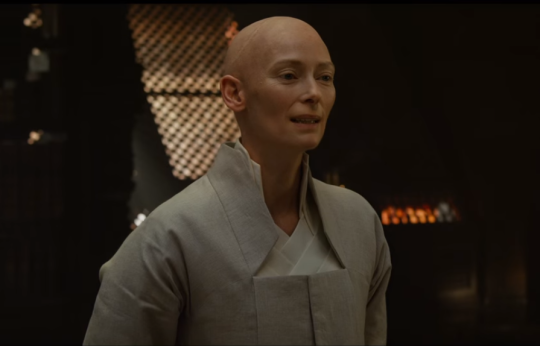
Is now this:
Yeah. And certain people are calling Marvel racist whitewashers etc, but here is the dilemma they had.
TAO is canonically Tibetan. All the mysticism and power of the character, and by extension that which he teaches to Dr Strange is influenced by this fact (not necessarily accurately but thats another story). Now this would never be an issue at all, except for a small group of people known as the government of the People’s Republic of China. For those who don’t know, China thinks they own Tibet, they invaded it back in 1950 and have fought against any major dissension of their claim to it ever since, be it political or otherwise. So basically, the Chinese government was not happy, and a boycott was on the cards if the character was depicted as Tibetan instead of Chinese.
Well Marvel can’t then just make TAO Chinese, coz thats a big ol’ Fuck You to the Tibetan people, and they can’t make TAO Tibetan because then they lose a billion person audience AND could potentially sour US/China relations (yes, the Chinese take this THAT seriously). Marvel’s comics back in the day may not have given a fuck, but their movie industry now is not in a position to be making decisions that could have serious political consequences. You could say “well why not switch to a different Asian culture entirely”, but then they run into the mire of treating Asian cultures as an amorphous blob that are easily interchangeable, which is not a good thing to do and you know for a fact would get them called racists anyway. Which in itself was an additional minor reason for the change, since the original Ancient One had some pretty tired and stereotypical Asian trope nonsense going on, which given current accusations that major Asian characters are always mystic ninja types, Marvel didnt want to deal with seeing as its hard to write a mystic without the mysticism.
So this is what happened. Is it ideal? No. Is it fair? Not really. But given the shit circumstances here, it is hardly fair to be piling all the blame on Marvel, and certainly to put any blame on Tilda.
Well, that’s disappointing to hear. “Lesser of two evils” is painful.
damn, i didnt know this. it sucks that marvel was kinda backed into a corner by political shit.
Option three, the one that would most likely solve this particular nasty problem: DON’T MAKE THE FUCKING MOVIE UNTIL THIS POLITICS SHIT HAS BEEN RESOLVED AND GIVE US A STANDALONE BLACK WIDOW MOVIE INSTEAD YEAH?! IT’S NOT LIKE THERE WON’T BE A WHITE WOMAN IN THAT ONE IF YOU MUST HAVE A WHITE WOMAN IN YOUR MOVIE.
Good point to this plan: Yay Black Widow movie, which is overdue by forever. Bad point to this plan: exactly when do you think this will be resolved? Because its 66 years and counting and its the strongest and most polarizing its ever been. The movie would be on hiatus indefinitely.
Who knows: humans are fickle creatures and the situation could get neatly resolved within our lifetime through cosmic circumstances and deus ex machina or it could drag on forever.
Mainly, I don’t know, but I also don’t care about Dr. Strange ¯_(?)_/¯.
Also they’ve reportedly already changed the movie to saying the Ancient One is Nepalese instead of Tibetan – again, to get around this terrible political situation with China – so ummm they could have you know. cast a Nepalese actor/actress instead of Tilda “David Bowie Wasn’t Available” Swinton. I mean, that’s straight-up yellowface, this is goddamn 2016. :P
Especially since they have Dichen Lachman available as an actual Nepalese actress. Yes, she’s already playing a different role on AoS, but come on, sufficiently different costuming, makeup, writing, etc. should be enough to let her play two distinct characters.
Also, seriously, Dr. Strange is a property that really could have been left off indefinitely without running out of cool Marvel things to make movies out of.
TV’s only Asian-American superhero opens up about the need for representation onscreen—and why her band of SHIELD agents totally belong in Marvel’s movies.
“Four years ago, Marvel’s Agents of SHIELD star Chloe Bennet was known professionally as Chloe Wang, aspiring actress and teenage dabbler in Shanghai pop stardom. In the states, however, Hollywood casting agents were less than welcoming. At least until she changed her last name. “Oh, the first audition I went on after I changed my name, I got booked,” Bennet tells The Daily Beast, in an interview timed to Marvel’s Women of Power month. “So that’s a pretty clear little snippet of how Hollywood works.”
That audition was for the role of Hailey, an office assistant on ABC’s Nashville. That same year, Bennet was cast as the lead in Marvel’s first cinematic universe TV show, the Joss Whedon-created SHIELD. Over three seasons, Skye, a headstrong young “hacktivist” who gets recruited by SHIELD and eventually discovers her real identity, the half-Inhuman Daisy Johnson (a.k.a. Quake), has evolved into what is still a rarity on TV: a superhero who happens to be both female and Asian-American. “I wish people talked about that more,” Bennet says. “I don’t know if it’s good or bad, but when Supergirl came out, people were like, ‘This is the only superhero on TV that’s a female!’ And I was like, ‘Hold on! I’m pretty sure Daisy’s been here.’ And I also happen to be half-Chinese and I’m so proud of that.” “I want to be clear because some of my Asian-American fans seem to think I did that [changed last names] because I didn’t want to known as Chinese, but it’s so the opposite,” she adds. “I just wanted to be known as me and let my personality define who I was, rather than my ethnicity.” Bennet—who is loud and funny and blunt in conversation—then launches into her SHIELD audition story, told with a mixture of endearing self-loathing and pride. “When we were down to seven girls [up for the role of Skye], it was this completely diverse group of girls I was up against. And it was really about who was right for the part,” she says. “We were testing and we came out of the room and I was up next and Joss Whedon was there and said, ‘Hi.’ I got kind of nervous and looked at him. He just looked really tired. And I was like, ‘You look like shit’—this right before I went in for my last audition.
“He started laughing and was like, ‘Well I am tired,’” she says, groaning at the memory. “And I was like, ‘I mean, you look tired in a good way, like you’re really busy! And accomplished!’ It was so Skye Season 1 that I think he was like, ‘Yup, that’s her.’” Because of Marvel’s “cinematic universe” design, SHIELD takes place during the events of the comic book movie franchise’s big-screen exploits—meaning that whatever havoc the Avengers wreak in their city-smashing adventures has real-world consequences for the show’s on-the-ground SHIELD agents. When Captain America: The Winter Soldier revealed that the evil Nazi organization HYDRA had been embedded within SHIELD since shortly after World War II, the show, whose entire first season built up to the events of Winter Soldier, took that and ran with it, spinning out two seasons of intrigue.
But while Marvel’s movies often affect the show, SHIELD’s narrative rarely bears weight on the big-budget blockbusters—even when the stories it’s telling should. In the upcoming Captain America: Civil War, for example, Marvel’s superheroes choose whether to submit to official government oversight, a measure (called the Sokovia Accords, the onscreen version of the comic books’ Superhero Registration Act) pushed on them by a United Nations panel.
Incorporating SHIELD’s ongoing Inhumans storyline would actually raise the stakes of the movie: the presence of hundreds if not thousands of undiscovered Inhumans (people with the ability to develop superpowers) would give governments extra incentive to push the Sokovia Accords on all superhumans. Recent interviews with Civil War directors Joe and Anthony Russo, however, indicate the directing duo are entirely unconcerned with what’s going on in the world of SHIELD.
“I think we’re all on the same page besides them,” Bennet says, sighing at the missed opportunity. “But they’re gonna do what they’re gonna do, and I’m really happy with our little show. We’ve been dealing with the topic of Civil War for a while now—at least, Daisy has. She’s a SHIELD agent but also a human and she’s completely torn.”
If Bennet had her way, of course, Civil War would bring certain SHIELD-specific changes to the Marvel universe: “I would like us to be put in the movie,” she laughs. “That would make sense. I would like the Avengers to find out that Agent Coulson’s still alive. And Daisy’s incredibly powerful. I think you’ll see toward the end of the season her strength as a character and a leader, and her power as a superhero really expands—I’m just saying, the Avengers could use our help, if they just asked.” Marvel’s TV universe, in the meantime, continues to expand, with street-level heroes like Daredevil, Jessica Jones, Luke Cage, and Iron Fist getting their own Netflix shows. With the latter series’s casting announcement—revealing that Game of Thrones actor Finn Jones will be taking on the role of Danny Rand—a familiar refrain decrying the MCU’s lack of diversity reverberated across the Internet again. When asked if she was among the thousands calling for the traditionally white Danny Rand—a kung fu master—to be played by an Asian actor, Bennet answers without missing a beat.
“One-hundred percent. I actually saw that [casting] news and I can’t lie, I was a little [disappointed],” she says, before breaking into laughter again. “I love Marvel, but…” “I know they want to stay true to their characters but, you know, every female character in Marvel comics also has, like, triple-Z-sized boobs,” she reasons. “So if they cast actors based on the way characters look on the page, I don’t think even Scarlett Johansson—well, maybe Scarlett Johansson—would be in the movies.”
As for Marvel’s ever-expanding movie arm—which will feature its first character of color in a standalone film in 2018’s Black Panther—Bennet maintains there’s room for improvement there as well. “I think they could do better,” she says. “You know, there are a lot of white guys named Chris. But I think they will, because it’s important. It’s the right thing to do. Marvel’s a smart company and I think they will represent their fans from around the world. They can take note from the way we’re going on the show, ‘cause we’re doing a pretty good job.”
Bee covered the hypothetical threat of trans peeing on Full Frontal With Samantha Bee last night, pointing out that a trans person has never been accused of assaulting someone in a bathroom. Tennessee lawmaker Jeremy Durham, on the other hand, has been accused of inappropriately touching and otherwise sexually harassing his female employees, including texting two women late at night and asking them to send him nude pictures of themselves. So it’s a bit ironic that Durham supports “protecting” the girls and young women of Tennessee from the prospect of a trans person in the stall next to them, no?
Honestly, I’m just livid that David Cameron isn’t even trying at this whole tax evasion lark. He’s done his best, I grant you. He’s tried.
However, he could stand to learn a lot from his ancestors, because honestly, until he’s bricked up all his windows and hand-painted his own wallpaper, I cannot take him seriously as the tax evader he’s always dreamed of being.
in 1662, Parliament imposed a tax on the number of hearths in a household, with every hearth (including stoves and fireplaces) costing one shilling in tax twice a year. The thinking behind this was that it was too hard to do an accurate population count, and the number of hearths pretty much corresponded to the number of people in a household. This wasn’t a new tax; it had been levied before in the Byzantine Empire and other European countries, but there was one major difference; British people have tax avoidance in their blood. Subsequently, the tax became something of a problem when people began knocking down their chimneys and blocking up their hearths to try and hide the number of fireplaces they had. Some people kept lighting their hearths without adequate ventilation, having removed their chimneys, which is generally what is known as a Very Bad Idea. 4 people died when a baker tried to join her stove to her next door neighbour’s chimney and caused a fire to break out, burning down 20 houses. The tax was withdrawn in 1689. People’s thirst for tax evasion had to find another outlet.
in 1696, a window tax was established in England and Wales. Income tax was not A Thing, because people thought that declaring their income was an invasion of personal liberty, so the government tried to find other ways of making rich people pay more tax than poor people. This was a problem, until one day someone had the thought ‘hey, rich people have bigger houses than poor people! That means more windows! Lads, I’ve solved the problem’. The tax took a few different forms before it was repealed in 1851, but essentially you paid a proportion of extra tax on every window you had over 10, and a larger proportion for every window over 20. Can you even imagine the tax that the property owner of Buckingham Palace would have had to pay if the property owner of Buckingham Palace paid taxes? Madness. Today, many old buildings in Britain can be seen to have bricked up spaces where windows should be. Architectural choice? Lazy repairs? Nope. Tax avoidance. Unwilling to pay more tax just because they had the audacity to earn more money and own bigger houses, people started bricking up their windows to avoid paying the tax. Who needs natural light and ventilation when you can save money on your tax bill?
the thirst was sated in 1712, when a tax on patterned wallpaper was introduced. One of the weirder taxes ever imposed, this demanded that people pay a tax on every square yard of wallpaper which was sold with a pattern or colour on it, either stained, printed or painted. Again, the thinking behind this was pretty sound, in a way – wallpaper was phenomenally expensive, a luxury that only the very richest within society could afford. There were even reports of the uber rich spending more money on wallpaper for one room than the cost of their houses. With this super rich clientele, the tax effectively acted as a tax for the richest people in society. Naturally, this one was a fairly easy tax to avoid, and, being applicable only to the top 10% of society, it was avoided like the plague – people started buying plain wallpaper and decorating it after it had been put on their walls. A trade developed around this idea, with people becoming skilled in stencilling designs directly onto papered walls. So, although it was pretty terrible in terms of tax collection, it was pretty great for the artistic community.
in 1784, a tax was levied on men’s hats. There’s no way of phrasing that without it seeming ridiculous, because it was ridiculous. As with so many previous examples, it was an attempt at taxing the richest members of society without directly taxing their income – the government thought that rich men were more likely to own a lot of expensive hats, probably with feathers and shit, and so the tax would affect them substantially more than Joe Poor, who only owned a flannel cloth fashioned out of a dishrag that he wore as part of his Sunday best. Poor Joe Poor. The way the tax was implemented, hat vendors – known as milliners to those who like their fancy words – had to register as a hat seller, and stamp all their hats with revenue stamps, saying how much it cost. The more the hat cost, the more tax was paid. If a hat seller was caught failing to do this, they were liable to pay enormous fines, and there was even the threat of the death penalty for those who forged revenue stamps, which honestly I need to see in a period courtroom drama immediately. Being British and also the associates of the very very rich, these milliners stopped selling hats. Instead, they began selling headgear, head adornments, accessories for the head, and things that definitely weren’t hats. By selling them under a different name, the tax could legally be avoided. Realising that there is no end to the possibilities of brand jargon when marketing is involved, and that they wouldn’t be able to stop the evasion even if they called the tax something ridiculously broad like ‘the tax on things you wear atop your cranium’ tax (because the milliners would just start selling ‘things you adorn the top of your body with’) the government repealed the tax in 1811.
in the same year, 1784, a tax was levied on bricks. Every individual brick wasn’t taxed, because that would be absolute madness, but for every thousand bricks used in construction, a tax would be paid. The reason behind this tax isn’t because it targeted the super rich, but because George III needed a quick injection of cash to fund his wars in the Colonies, and – well, bricks are used a lot. Like, a hell of a lot. There are so many bricks. In response to the tax, many manufacturers began constructing buildings using absolutely massive bricks. Even today, you can see this in the architecture of surviving Georgian buildings – some of the later extensions are built using bricks of a noticeably larger size. As with the window tax, this isn’t so much architectural experimentation as (actually understandable, kind of) tax evasion. The government then began to tax bricks by volume, rather than number, and by 1850 when the tax was abolished, the industrial development of the country had been affected fairly badly. Unable to afford the tax, many brick manufacturers had to shut down. Buildings were constructed out of timber and siding instead, which is fine I guess.
“Mama, why do we all have rickets?” “Because Papa’s cheap, children.” (x)
I think the hilarious part is that tax avoidance must be a Brit thing… Hell there was a sizable amount of folks who wanted to avoid taxes, that they fought a war to leave.
Ah yes, the biggest tax evasion scheme of all.
Ah yes, not wanting to pay taxes to a government that bleeds you and doesn’t use your taxes for your community. How scheming.